
There is no Convivence Without Good Communication
The 160th anniversary of the creation of the International Telegraph Union (ITU)
The history of the ITU is the story of human connection, part of an essential Convivence. It began by linking peoples and continents through telegraph cables and today manages the flow of digital data, the foundation of our global economy and society. Celebrating its 160 years means recognising that, behind every call, every text message and every online video, there is more than a century and a half of collaborative work, standardisation and a shared vision: communication as a fundamental right and a force for global progress in support of Convivence.
Celebrating the 160th anniversary of the creation of the International Telegraph Union (ITU), the precursor of today’s International Telecommunication Union (ITU), means recalling one of the fundamental pillars of global communication. In the mid-19th century, the electric telegraph was a revolution. For the first time, messages could travel faster than a train or a ship. However, there was a major problem: the lack of standardisation. In response to this need, France took the initiative and convened 20 countries at a conference in Paris.
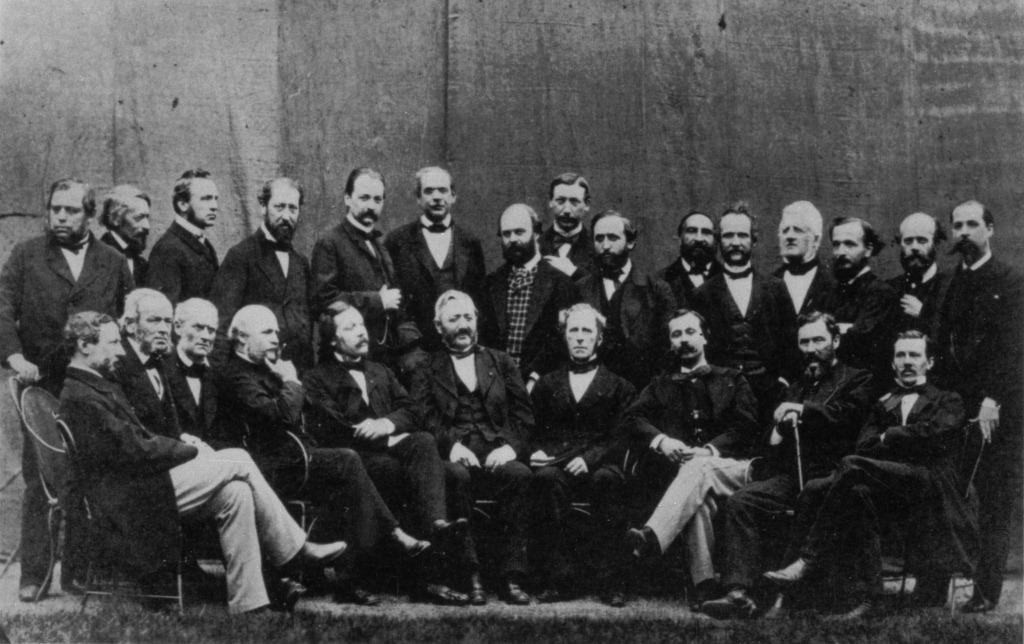
Twenty founding states signed the International Telegraph Convention and created the International Telegraph Union (ITU) in Paris on 17 May 1865. These twenty countries met under the presidency of Édouard Drouyn de Lhuys and signed the first international telegraph convention, creating the organisation we know today as the ITU. England was not invited to the conference, as its telegraph services were in the hands of private companies.
On that day, the representatives signed the first “International Telegraph Convention” and created the International Telegraph Union with the aim of establishing common technical standards to ensure the interoperability of international telegraph networks. It was agreed to create Telegraph Regulations, which standardised matters such as tariffs, message priorities and, above all, codes of conduct for operators.
It was a historic milestone; the ITU became the first permanent international organisation dedicated to technical matters, setting a precedent for global cooperation and better understanding among peoples.
With the invention of radio, wireless telegraphy by Marconi and others, a new means of communication emerged that transcended borders. The ITU had to adapt. It did not rest on its laurels. Its evolution has been parallel to that of technology:
Telephony and radio: it managed the radio spectrum at the global level, allocating frequencies to avoid interference between countries (from civil aviation to radio broadcasters and communication satellites).
Television and satellite communications: it established standards for colour television (such as PAL, SECAM and NTSC, although digital standards are now used) and coordinated the orbits of communication satellites.
Digital era and the Internet: its role has become more critical than ever:
Technical standards (ITU-T): it develops the standards that make data communication possible, such as X.25, as well as video compression (H.264 and H.265) and broadband protocols.
Spectrum and orbits (ITU-R): it coordinates the use of the spectrum for technologies such as 5G, Wi-Fi, GPS, as well as the geostationary orbits of communication satellites.
Development (ITU-D): it works to bridge the “digital divide” by bringing access to the Internet and telecommunications to developing countries.
At 160 years old, the ITU is an indispensable organisation. Its current and future challenges include:
- Ensuring cybersecurity in public networks.
- Governing artificial intelligence (AI) in telecommunications.
- Connecting the unconnected (billions of people still lack access to the Internet).
- Managing the transition to 6G.
- Promoting net neutrality and digital rights in a hyperconnected world.
Groups of engineers and both ad hoc and permanent working teams propose standardisation recommendations which, once approved, become standards to be followed by telecommunications equipment manufacturers worldwide.
Madrid 1932: where telegraphy became telecommunication
In the history of global communications, while Paris holds the title of birthplace of the International Telegraph Union in 1865, Madrid occupies an equally crucial place: that of its renaming. It was in the Spanish capital that, in 1932, the organisation evolved to adopt the name that is today a pillar of the digital world: the International Telecommunication Union (ITU), with representatives from more than 80 countries.
The objective was ambitious: to unify all forms of long-distance communication within a single legal framework. The result was the signing of the Madrid Convention. The most symbolic act of this conference was the decision to merge the ITU and the International Radiotelegraph Union (IRU) into a single organisation. To reflect this new integrative reality, spanning from the telegraph to radio, a new name was chosen: the International Telecommunication Union (ITU). Thus, an institution ready for the future was born.
The Madrid event was not merely a change of name; it was a redefinition of the organisation’s mission. It marked the transition from an era centred on a single technology (the telegraph) to a comprehensive vision of “telecommunications”, a term encompassing all forms of long-distance communication. For this reason, Madrid represents an essential chapter in the history of the entity that today governs the radio spectrum and lays the technical foundations of our digital era.
Nicolás Puerto Barrios
Technical Telecommunications Engineer. Córdoba


